Old San Juan sits on a narrow islet at the entrance to San Juan Bay, a fortified city founded in 1521 that has spent five centuries layering history onto its blue cobblestone streets. For anyone with even a passing interest in architecture, walking these blocks is like flipping through a textbook that happens to be painted in every colour imaginable.
The Spanish Colonial Foundation
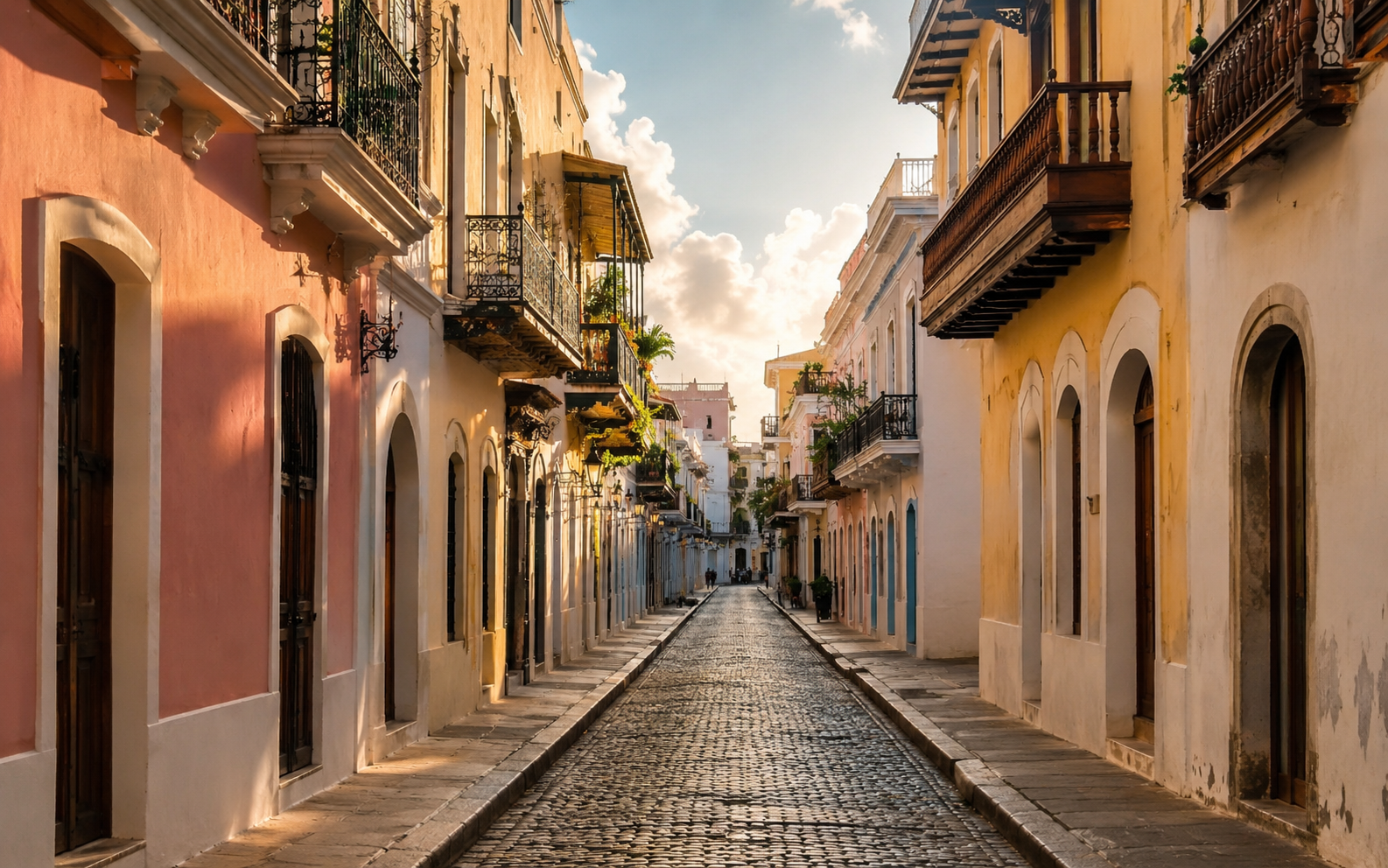
The oldest buildings in Old San Juan date to the sixteenth century, when Spain established the city as a military stronghold guarding its Caribbean trade routes. El Morro and San Cristóbal, the two massive fortifications that bookend the old city, are the most visible remnants of that era. But the colonial influence runs deeper — into the thick-walled townhouses with interior courtyards, the wrought-iron balconies that overhang narrow streets, and the churches whose facades have weathered centuries of hurricane and salt air.
The layout itself is colonial: a tight grid oriented to catch trade winds, with plazas at intervals where civic and religious life converged. It is a pattern repeated across Spanish America, but Old San Juan preserves it with unusual completeness.
The Colour That Defines the District
What strikes most visitors first is the colour. Building facades in Old San Juan range from soft pastels to vivid primaries — terracotta, ocean blue, sunflower yellow, deep coral. This is not accidental. A decades-long restoration effort has encouraged property owners to maintain historical colour palettes, and the result is a streetscape that photographs beautifully from every angle.
The historic district draws visitors year-round precisely because this visual identity is so consistent. Every alley rewards a detour.
Layers of Influence
Spanish colonial is the dominant style, but Old San Juan also reflects neoclassical, art deco, and Caribbean vernacular influences layered on over the centuries. Some buildings mix all four. The former Casino de Puerto Rico, now an events venue, is an exuberant example of early twentieth-century neoclassical design. Nearby, simpler wooden structures with jalousie shutters reflect the practical architecture of a tropical climate.
Visiting With Intent
The best way to experience Old San Juan is on foot, early in the morning before cruise-ship passengers flood the streets. Start at the Puerta de San Juan — one of the original city gates — and walk uphill toward El Morro. Stop at Capilla del Cristo, wander through Plaza de Armas, and let yourself get lost in the side streets south of Calle Fortaleza.
Bring comfortable shoes. The blue adoquine cobblestones are beautiful, but they are uneven and slippery after rain. Bring a camera too — Old San Juan is one of those rare places where every street corner composes itself into a photograph without any effort at all.